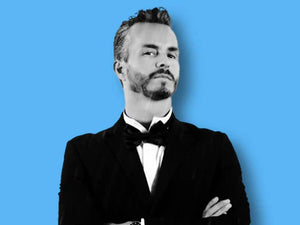

Seva Ustinov
We recently welcomed Seva Ustinov to the BASA Awards Judging Panel. As the founder and CEO of Plurio, an AI-powered marketing technology company, Seva has spent more than two decades helping businesses grow through digital channels. He shared his perspective on entrepreneurship, leadership, AI, and why taking action remains the foundation of success.
Every company seems to be talking about AI, but turning that promise into practical value is another matter. How is Plurio changing the way marketing teams work?
Plurio is a leader in AI-powered solutions for performance marketing teams, helping marketers manage anywhere from hundreds of thousands to millions of dollars in advertising spend across platforms like Google, Meta, and TikTok.
AI agents take repetitive, time-consuming work off marketers’ plates. Instead of doing everything manually, teams can use them to optimize large numbers of ads, conduct deep data research, and manage routine workflows. That frees up time for the work that requires human thinking while making marketing teams more efficient.
Digital marketing has given businesses more ways than ever to reach customers. How has that changed the way advertisers think about audiences and campaigns?
I think the biggest shift is that advertising is no longer about creating one narrative for a huge audience. Today, with digital channels, influencers, search platforms, and social media, success comes from understanding much narrower audiences and finding what resonates with each of them. You have to communicate the problem you’re solving and the value you’re providing in an incredibly short amount of time. Instead of running a single national campaign, businesses are now creating hundreds, or sometimes thousands, of audience segments, each with its own message, value proposition, hook, and call to action. That’s actually a good thing because it allows businesses to speak more directly to people’s needs and create much more relevant experiences for consumers.
The challenge is that it becomes far more complex to manage at scale. Performance marketing today is about understanding hundreds of audiences, testing hundreds of ideas, and making creative decisions based on data.
"Advertising is no longer about creating one narrative for a huge audience."
If you were advising a small but ambitious business with a limited marketing budget, where would you tell them to focus first?
If you’re a small business with a limited marketing budget, the first place I’d focus is testing. Try different channels, hooks, problem statements, value propositions, and offers. Whether you’re promoting a service, a webinar, a piece of content, or a product, the objective is to test different combinations until you find what works.
One of the advantages of being a small business is that you don’t need a large marketing team to do this. You can often do it yourself or with the support of just one other person. You’re also much closer to your audience. You know your customers, receive direct feedback, and understand what people care about. That’s often enough to identify the right combination, refine it over time, and eventually scale it.
There’s a lot written about leadership, but in your view, what separates leaders from people with good ideas?
To me, leadership has always been about making things happen. When I was younger, I saw many people talking about starting businesses or pursuing new ideas. Leadership meant actually doing it: registering the company, building a website, finding your first customers, and simply taking the first step.
That definition hasn’t really changed. It’s taking action without external pressure, identifying the next bottleneck, and choosing to solve it because you care about building something valuable.
"Leadership is about making things happen."
Your career has taken you across different countries and markets. What has been the biggest lesson from building a business globally?
Everything started when I came to San Francisco for a conference. I spent time meeting people and exploring the area, and it didn’t take long for me to feel I was in the right place. There were ambitious entrepreneurs everywhere, all focused on building interesting things. Once I made the decision to become part of that community, everything else followed. The next step was simply getting out there. If you want to acquire customers in a new country, you have to talk to people, start selling, gather feedback, and learn from other entrepreneurs. Looking back, one of the biggest mistakes I made was worrying too much about cultural differences. I questioned whether my experience and expertise would be relevant in a different market, but in reality, it was a form of country-level imposter syndrome.
One thing I’ve come to appreciate is that building a successful business already takes years. If expanding into a new country adds more years to the journey, it’s still a worthwhile investment. The earlier you start, the easier it becomes to navigate a new market.
Trust plays a critical role in business. Where do awards fit into that equation?
Customers don’t have time to learn everything about every company. Most buying decisions come down to trust, so people either rely on recommendations from someone they know or look for social proof.
Awards, case studies, testimonials, and measurable results all provide that proof. They show that someone else has already validated the quality of a business and its work. For small businesses looking to grow beyond their local community, that kind of validation helps build trust with people who have never heard of them before.
For more information about Seva Ustinov and Plurio, visit Plurio


MEET THE JUDGES

Xile He
We recently welcomed Xile He to the BASA Awards Judging Panel. As Head of Gro...
Steph Briggs
We recently welcomed Steph Briggs to the BASA Awards Judging Panel. Founder o...
Stacey Ross Cohen
Stacey Ross Cohen is the CEO of Co-Communications, an author, speaker, educat...
Seva Ustinov
We recently welcomed Seva Ustinov to the BASA Awards Judging Panel. As the fo...
Scott Pipitone
We recently welcomed Scott Pipitone to the BASA Awards Judging Panel. As CEO ...
Heather Holmes
We recently welcomed Heather Holmes to the BASA Awards Judging Panel. Heather...
Dr. Tamara Nall
The BASA Awards recently welcomed Dr. Tamara Nall to the BASA Awards Judging ...
Davis Richardson
Davis Richardson is the founder of Paradox and is also the CEO of AUSP Inc., ...
Catherine Delcin-Zilpa
Catherine Delcin-Zilpa is the founder of Delcin Consulting Group, a boutique ...
Annie P. Ruggles
The BASA Awards recently welcomed Annie P. Ruggles to our Judging Panel. A st...
Akhil Verghese
We recently welcomed Akhil Verghese to the BASA Awards Judging Panel. As co-f...
Michele Allen

Nitin Kishen
Dennis Galletti

Awais Sher Bajwa
Sharon Bonner

Jessica Willis
Kellie Dyer

Devon Montgomery Pasha

Ashish Kedia

Ramlakshmi Murugan
Dr. Rod Segnini

Dr. Tejesh Reddy Singasani

Derrin Brown

Nikhil Patil

Tania Tome
Tania is a highly accomplished and multifaceted professional known for her ex...
Dennis Reno
Customer Experience and Customer Success Executive with 30+ years of professi...
Sudha Ranganathan, LinkedIn
Sudha, a seasoned professional with 18 years of experience at P&G, Nielse...
Sumit Sanwal, American Express
Sumit is an IT leader, with 20+ years of experience in top leading financial ...
Sir. Cristiana Tudor, Greatness Media
Sir. Cristiana is a seasoned branding and storytelling educator whose goal is...
Param Singh, Oberon Securities
Param is an accomplished Vice President at Oberon Securities, leveraging over...
Tom DuFore, Big Sky
Dr. Tom DuFore is the CEO of Big Sky Franchise Team, where he is responsible ...
Jessica Tiller, Pugh & Tiller PR
Jessica is a PR executive with two decades of public relations experience dev...
Mia Still Osorno, MSN Talent
Mia Still Osorno is the CEO and founder of MNS Talent and Consulting, 9 to Th...
Rachel Russell, EY
I connect with business leaders of high-growth companies and strategically po...
Matteo Osso, QVC TV
Matteo is a TV personality, radio host, and personal branding expert.
Anna Stella, BBSA
Two-time national award-winning marketing expert, academic researcher.